Showing posts with label challenges in agriculture. Show all posts

Friday, 10 May 2013

FRUIT TRENDS DRIVE FOOD, BEVERAGE PRODUCTS

So what's happening in the fruit business to drive food and beverage trends?  Check out this article in Food Product Design.

ROCKVILLE, Md.—Fruit moves beyond its natural, nutritious flavorful qualities as its versatility and cultural role make it a vehicle for food and beverage advances that take it beyond snacks and juices into a variety of new products offering health, flavor adventure and artisan experience, according to a new report from the Center for Culinary Development (CCD) and market research publisher Packaged Facts.
The "Fresh Takes on Fruit: Culinary Trend Mapping Report breaks down fruit trends by tracking developments across CCD Innovation's proprietary Trend Map®, outlining five stage trends of today and what to expect from them in the future to support innovative and traditional brands in food service and packaged goods.

Stage 1 trends focus on craft cider and fruit preserves. Artisan alcoholic cider is the next big brew trend, appealing to consumers who are increasingly health conscious and imbibe. Also, with growing attention on preservation, a renewal of nostalgia-driven interest in old techniques can be see among top chefs and DIY home cooks.

Stage 2 trends include the use of sugar from fruit. Monk fruit and coconuts are being transformed into sweeteners with low calories, low glycemic index scores and impressive nutrient profiles. New varietal fruits and hybrids are also gaining popularity as consumers focus on quality and variety. Shoppers are focusing on specifics like Meyer lemons, Cara Cara oranges or Seascape strawberries that offer distinct flavor profiles and qualities like textural advantages.

Stage 3 focuses on the addition of botanical flavors to fruit-flavored beverages. This trend adds a fresh twist to the category. Consumers are looking for more complex flavor combinations and alternatives to conventional sodas. In addition to taste, the potential health benefits appeal to consumers seeking elixirs in a bottle or tea bag.

Stage 4 involves the expansion of tart cherries into juices, snack bars and trail mix. This nutrient powerhouse has many future application capabilities. Tart cherries are a good-for-you ingredient that add great taste, a premium feel and a hint of nostalgia to foods.

Lastly, Stage 5 highlights the current mango-craze trend. Its tropical flavor has broad appeal to multicultural consumers, flavor lovers and health-seekers. Whether in savory or sweet applications, mango's versatility expands across CPG and food service menu categories.


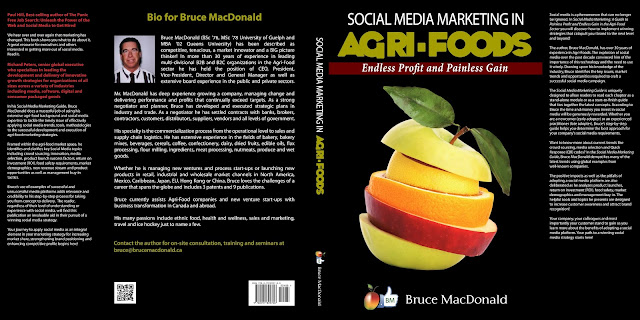
Check out my latest e-book entitled: "Social Media Marketing in Agri-Foods: Endless Profit and Painless Gain".  


The book is available on Amazon and Kindle for $4.99 USD. Visit amazon/Kindle to order now:
http://www.amazon.ca/Social-Media-Marketing-Agri-Foods-ebook/dp/B00C42OB3E/ref=sr_1_1?s=digital-text&ie=UTF8&qid=1364756966&sr=1-1

Written by Bruce MacDonald, a 30 year veteran of the Agri-food industry, in "Social Media Marketing in Agri-Foods: Endless Profit and Painless Gain", Bruce applies his background and expertise in Agri-foods and social media to the latest trends, tools and methodologies needed to craft a successful on-line campaign. While the book focuses on the Agri-food market specifically, I believe that many of the points Bruce makes are equally applicable to most other industries.

Tuesday, 23 April 2013

Intelligent Sensing Agriculture Robots To Harvest Crops


Check out this great article by Jennifer Hicks on the next generation of robotics in the global agricultural arena published in Forbes.com.   Agriculture might be the last place you would think to look for robots. To be more specific, high value crops such as greenhouse vegetables, fruits in orchards and grapes for premium wines. But it does make sense. Anything that technology can do to foster the sustainable development of agriculture benefits the world.
A new project that’s part of the European Union Seventh Framework Program (FP7) cRops (Clever Robots for Crops) is focusing on creating robots to harvest high value crops.
The cRops robotic platform will be capable of site-specific spraying (targeted spraying only on foliage and selected targets) and selective harvesting of fruit. The robots will be able to detect the fruit, sense its ripeness, then move to grasp and softly detach only the ripe fruit. Another objective of cRops is to develop techniques for reliable detection and classification of obstacles and other objects to enable successful autonomous navigation and operation in plantations and forests.
Projects like cRrops are significant because they can accelerate sustainable development of agriculture.
– Catherine Simon, Innorobo
The European project, made up of universities and labs from 10 different countries including Netherlands, Belgium, Israel, Slovenia, Sweden, Italy, Spain, Germany, Chile and France started in October 2010, but sources say it will take at least five more years before it could be commercialized. So why is Europe moving so slowly in terms commercializing robots and moving them into mass market?
“One of the main reasons is simply because robotics is still in an early stage of maturity and we continue to see projects coming out of academia, government or EU commissions,” said Catherine Simon, Founder and organizer of Innorobo, the leading robotics conference taking place in Lyon, France in 2013.  “Europe needs to make the shift from projects to product faster like the United States if we want to remain a leader in the the field of robotics. If the cRops project were to focus on detecting one specific type of fruit, it might be a shorter path to market. But in this case, with multiple countries, government funding, demand for subsidies and coordination across associated agencies, it slows the innovation process.”
Simon’s point about targeting a specific fruit or problem is key. Harvest Automation, based in Boston, MA, raised $7.8 million in a series B funding round in November 2011. Harvest is focusing on agricultural robotics and focusing on greenhouse and nursery automation. They want to resolve acute manual labor problems across multiple industries but are starting with agriculture.  The Harvest Automation robot costs around $25 to $50k and because the manipulation requirements of the robots are lower in this sector, the company focus on creating a viable business, reducing costs and higher yields, rather than worrying about how to incorporate expensive robot arms into their operations.
But, there are other fruit picking robots on the loose. In Japan in 2010 the Institute of Agricultural Machinery’s Bio-oriented Technology Research Advancement Institution, created a strawberry picking robot with a stereo camera system that images the strawberries in 3D and image-processing algorithms determine their ripeness. If a strawberry is at least 80 percent red, the machine snips it at the stem and puts it in a padded bin. It can harvest 60% of the strawberry crop, taking only nine seconds to pick a strawberry. But, according to a machine-vision specialist who worked on the strawberry picking project, this robot won’t happen without government subsidies.
But times are changing. We are starting to see a true shift in the ecosystem surrounding robotics – moving from a heavily academic foundation to a more entrepreneurial approach.  In 2011, Hizook reported that VC funding in robotics surpassed $160 million, with Restoration Robotics taking a whopping $43 million (an image-guided hair transplant robot). And with outsiders like Dmitry Grishin, Founder, Grishin Robotics, believing it’s time to open up the insular world of robotics to entrepreneurs and raise the profile of the robotics industry, and insiders like Bruno Bonnell, Robultion Capital in France establishing Europe’s first robotics fund dedicated to service robotics toGoogle investing quietly in robotics in the form of cars that drive themselves, the race is on.