Tuesday, 16 April 2013

What are the hottest global trends to watch for in 2013?


100 Must Watch Trends in 2013

A closeup of a Bald Eagle. Taken at falconry d...
Here is the latest on 2013 trends according to Forbes.  You don’t need eagle eyes; you just need this long list from JWT.  Ann Mack and her team at JWT have hit a homerun.
In my years as a technology writer and researcher, I’ve seen more than my fair share of prognistication. Trend watching can be a combination of navel gazing and crystal ball massage. CES (Consumer Electronics Show) certainly inspires some of it. We’re a nation, perhaps a world, of wanting what comes next.
Here’s the BIG list, with a few links thrown in for ones I like or know about. I downloaded the Slideshare presentation as a PDF, then converted the page that listed out the trends into text. But the full links to both Slideshare (almost 100,000 views) and JWT’s useful overview are linked below.  IF YOU know of some great links that tie to these products/services/trends, drop me an email. LONG, long list so keep scrolling. The end has the link you’ll want to follow to JWT.
  1. 3D Bioprinting (Terry Wohlers is my go-to guy for 3D printing anything, so visit his research / benchmark reports)
  2. Adult Playgrounds
  3. African Tech Stars
  4. Allergen-Free
  5. Alternative Brand Currencies
  6. Ambushed by Amazon
  7. Appcessories
  8. The Arabic Web
  9. B2C/P2P Partnerships
  10. Bee Venom
  11. Biometric Authentication
  12. Blocking Social Media Bores
  13. “Cloaking”
  14. Chia Seeds (they are cool looking floating in those drink bottles)
  15. Click-and-Collect Shopping
  16. Coaching Brands
  17. Cool Techie Camps
  18. Crowdsourced Translation
  19. Cutting out the Middleman
  20. Cyber War
  21. Dads in the Aisles
  22. Data Scientists: The New Hotshots (Tableau is great visualization software for data science types)
  23. Decline of Chinese Bling
  24. Desalination
  25. Detoxifying Life
  26. Digital Ecosystems
  27. Drones
  28. ecoATM
  29. Egg Freezing
  30. Emotion Recognition
  31. The End of Voicemail
  32. Faux Meat
  33. Fitness Beyond The Gym
  34. Flexible Screens
  35. Food Sharing
  36. Frontier Markets
  37. G20 Devolves To G-Zero
  38. Gender-Blurred Toys
  39. Geofencing
  40. Green Growth
  41. Handwriting = Hieroglyphics
  42. Hotels in Africa
  43. Human-Centered Tech
  44. Humane Food
  45. Hyper-Personalized Customer Service
  46. Impact Sourcing
  47. Imperfection
  48. Individual Attention
  49. Instant-Erase Apps
  50. JOMO (Joy Of Missing Out)
  51. Live-Streaming Life
  52. Low-Cost Robots
  53. Low-Tech Device Charging
  54. Media That Gets to Know You
  55. Medical Smartphones
  56. Menu-Free Dining
  57. Midcalorie Foods
  58. Mindful Living
  59. Mobile-Optimized Goes Mainstream
  60. MOOC Stars
  61. Nature As Antidote
  62. Neurotechnology
  63. New Digital Royalty
  64. News Bites
  65. NFC Tags (QR tags or Barcodes on steroids?)
  66. Objects With Attitude
  67. Offset Thinking
  68. Online Groceries
  69. Paperless Education
  70. Passwords 2.0
  71. Patchwork Earnings
  72. Personal Data Ownership
  73. Prime Time for Second Screen
  74. Privacy Etiquette
  75. Quiet Products
  76. Reduced-Guilt Candy
  77. Responsive Web Design
  78. Retailers Enable Recycling
  79. River Cruising
  80. Self-Service
  81. Serialized Digital Fiction
  82. Set Jetting
  83. Shopping Hotels
  84. Social Media Hacks
  85. Standup Desks
  86. Stress-Monitoring Apps
  87. Sugru (I call this 21st Century Duct Tape and I love it)
  88. Tablet Shopping
  89. Tech-Enabled Farm-to-Fork
  90. Teff
  91. Trade School
  92. Trust Ratings
  93. User-Based Insurance
  94. Variable Pricing
  95. Vegetable Boxes
  96. Vertical Farming
  97. Video Games As Art
  98. Window Shopping
  99. Wireless Charging
  100. Yogurt Shops

JWT overview on the full 100 Things To Watch in 2013 post

JWT 100 Things To Watch In 2013 on Slideshare

A little more about Ann Mack. She is the director of trendspotting at JWT in New York. What a job, huh? Pretty exciting to do this kind of work, in my opinion. Most recently, according to her bio page, she led the development of JWT’s AnxietyIndex.com, which focuses on helping brands navigate consumer anxiety, and the re-launch of JWTIntelligence.com.

Top Chefs forecast Food Trends


According to a recent article in Forbes, top North American chefs forecast their picks for the top food trends in North America.  It’s no secret that fashion industry trends come and go; but trends are also a big part of the culinary world, especially in fine dining. When the Startle.com team set out to uncover the top foods, ingredients and cooking methods we can look forward to this year, we went straight to the source—some of the best chefs across the country, from Napa Valley and Beverly Hills to the Lowcountry of Charleston. Read on to see what these pros are forecasting for the world of food.
Executive chef Robert Curry
Robert Curry: Executive chef at Auberge du Soleil, Rutherford, Calif.
What are the hottest food trends in Napa Valley?
 Cultural and ethnic flavors are the new hottest food trends in Napa. People are seeking a little more diversity in their cuisine. Many chefs are expanding their menus and subtly incorporating ingredients and products that are outside of the style of their cuisine.
What foods are you hoping to see more of in 2013?
 I am always rooting for the culinary underdog. I love it when I go into a fine-dining establishment and see less glamorous vegetables like carrots and Brussels sprouts predominately displayed.  
Are you planning to cook with any new ingredients this year?
 I love going to the Asian and Middle Eastern markets to dig up new ingredients that I haven’t had a chance to work with. We will see what will be discovered in 2013. 
Hot:
 Tasting menus, fermenting, food trucks, sous vide.
Not:
 Gluten-free menus, liquid nitrogen.
Executive chef Chris Hastings, photo by Jason Wallis
Chris Hastings: Executive chef and owner ofHot and Hot Fish Club, Birmingham, Ala.
What are the hottest food trends inBirmingham? Ethnic foods: Korean, Chinese, Mexican and even Argentinian. Also, I see the polished casual scene emerging, meaning higher-quality food and service than a casual restaurant at very affordable pricing. In Birmingham, the food truck scene is still growing in a big healthy way.
What food trends would you like to see die? Foam; bacon on everything. 
What ingredients will become more prevalent in 2013? 
Less common foraged ingredients you can find in the wild—for example, lion’s mane mushroom, pine needles, wild hickory nuts. Also, new things from our waters and less traditional parts of the fish, like throats, collars, livers, heads, etc.
Are diners more adventurous than five years ago?
 Yes, much more. I think our nation’s obsession with food and access to information through blogs and social media allows people to be more knowledgeable about different foods, techniques and cultures, so they’re more willing to dive in.
Hot:
 Sustainable seafood, restaurant gardens, molecular gastronomy, charcuterie.
Not:
 Pop-up restaurants, gourmet/specialty burgers, foams.
Executive chef Sean Brock, photo by Peter Frank Edwards
Sean Brock: Executive chef and partner atMcCrady’s and Husk, Charleston, S.C.
What are the hottest food trends inCharleston?
 Ember cooking, growing your own food, and hanging and aging squab, ducks and game birds. In Charleston, cooking new species of fish from our waters that haven’t previously been used.
What foods are you hoping to see more of in 2013?
 I would love to see more of a focus on forgotten heirloom fruits and vegetables. It’s a fascinating subject and a delicious one. This year, I would really like to focus on vegetable cookery. I think that vegetables are the most challenging.
What ingredients will become more prevalent in 2013?
 Celtuce, pawpaws and goat.
Hot:
 Fermenting, pickling, sustainable seafood, restaurant gardens.
Not:
 Amuse-bouche, foams/froths, gluten-free menus.
Executive chef Scott Conant, photo by Brent Herrig
Scott Conant: Chef and owner ofScarpetta, Montage Beverly Hills;Scarpetta Miami Beach, Scarpetta Toronto and Scarpetta New York, plus Scarpetta and D.O.C.G. Enoteca in Vegas.
What are the hottest food trends in L.A.? I’m seeing more vegetables as the center of plate, like a roasted butternut squash with bacon vinaigrette. I think it’s for health reasons—people are keeping a better eye on those things today. But the cost of doing business is so insane, so chefs have to look at things in a different light. One way to do it is to choose vegetables over really expensive cuts of meat. Heirloom vegetables and original strains of vegetables—those are super interesting.
What food trends would you like to see die? I’m a lover of avant-garde cooking and molecular gastronomy, but in the wrong hands, those become wildly disappointing. Also, terra cotta plates.
What cooking methods will become popular this year?
 I think there will be a lot more wood grilling; things that are seemingly rustic and, in the right hands, really elevate the product. People are smoking a lot more stuff than they used to. I’ve seen smoked cauliflower a lot lately, and I love it.
Hot:
 Fermenting, charcuterie, amuse-bouche, specialty burgers.
Not:
 Pop-up restaurants, foams, liquid nitrogen, food trucks.

Sunday, 14 April 2013

Is Organic Agriculture "Affluent Narcissism?


According to an article in Forbes by Henry I. Miller and Richard Cornett there is a realistic concern whether the value proposition offered by organic foods is indeed valid.  Note that this is not my own view.
As can be seen from the popularity of international organic retailers like Whole Foods markets, organic foods are popular.  The U.S. market for organic produce alone was $12.4 billion last year.
Some of the devotion from consumers attains almost cult-like status, which is why a recent article by Stanford University researchers that was dismissive of health or nutritional benefits of organic foods created such a furor.
The investigators themselves were surprised by the result.  “When we began this project, we thought that there would likely be some findings that would support the superiority of organics over conventional food,” according to physician Dr. Dena Bravata.  The study, by researchers in the university’s Center for Health Policy and published in the Annals of Internal Medicine, was a meta-analysis in which results from the scientific literature were combined but no new, original laboratory work was conducted.  Data from 237 studies were aggregated and analyzed to determine whether organic foods are safer or healthier than non-organic foods.  They concluded that fruits and vegetables that met the criteria for “organic” were on average no more nutritious than their far cheaper conventional counterparts, nor were those foods less likely to be contaminated by pathogenic bacteria like E. coli or Salmonella.
Many devotees of organic foods purchase them in order to avoid exposure to harmful levels of pesticides.  But that’s a poor rationale: Non-organic fruits and vegetables had more pesticide residue, to be sure, but more than 99 percent of the time the levels were below the permissible, very conservative safety limits set by regulators – limits that are established by the Environmental Protection Agency and enforced by the Food and Drug Administration.
Ironically, the designation “organic” is itself a synthetic construct of bureaucrats that makes little sense.  It prohibits the use of synthetic chemical pesticides – although there is a lengthy list of exceptions listed in the Organic Foods Production Act  – but permits most “natural” ones (and also allows the application of pathogen-laden animal excreta as fertilizer).
These permitted pesticides can be toxic.  As evolutionary biologist Christie Wilcox explained in a September 2012 Scientific American article (“Are lower pesticide residues a good reason to buy organic?  Probably not.”): “Organic pesticides pose the same health risks as non-organic ones.  No matter what anyone tells you, organic pesticides don’t just disappear.  Rotenone is notorious for its lack of degradation, and copper sticks around for a long, long time.  Studies have shown that copper sulfate, pyrethrins, and rotenone all can be detected on plants after harvest—for copper sulfate and rotenone, those levels exceeded safe limits.  One study found such significant rotenone residues in olives and olive oil to warrant ‘serious doubts…about the safety and healthiness of oils extracted from [fruits] treated with rotenone.’”  (There is a well-known association between rotenone exposure and Parkinson’s Disease.)
There is another important but unobvious point about humans’ ingestion of pesticides: The vast majority of pesticidal substances that we consume occur in our diets “naturally,” and they are present in organic foods as well as conventional ones.  In a landmark research article published in the Proceedings of the National Academy of Sciences,University of California, Berkeley, biochemist Bruce Ames and his colleagues found that “99.99 percent (by weight) of the pesticides in the American diet are chemicals that plants produce to defend themselves.  Only 52 natural pesticides have been tested in high-dose animal cancer tests, and about half (27) are rodent carcinogens; these 27 are shown to be present in many common foods.”
The bottom line of Ames’ experiments: “Natural and synthetic chemicals are equally likely to be positive in animal cancer tests.  We also conclude that at the low doses of most human exposures the comparative hazards of synthetic pesticide residues are insignificant.”
In other words, consumers who buy overpriced organic foods in order to avoid pesticide exposure are focusing their attention on 0.01% of the pesticides they consume.
There seems to be confusion about these issues even at the American Association of Pediatrics (AAP), which in October released a report that appeared to endorse organic produce because of its lower levels of pesticide residues, while at the same time admitting, “in the long term, there is currently no direct evidence that consuming an organic diet leads to improved health or lower risk of disease.”
Perhaps the most illogical tenet of organic farming is the exclusion of “genetically engineered” plants – but only if they were modified with the newest, best, most precise and predictable techniques.  Except for wild berries and wild mushrooms, virtually all the fruits, vegetables and grains in our diet have been genetically improved by one technique or another – often as a result of seeds being irradiated or genes being moved from one species or genus to another in ways that do not occur in nature.  But because genetic engineering is more precise and predictable, the technology is at least as safe as – and often safer than – the modification of food products in cruder, “conventional” ways that can qualify as organic.
There are examples of new varieties of plants, including two varieties each of potatoes and squash and one of celery, that have sickened or killed consumers, but all of these were the result of conventional genetic modification – which would qualify for organic farming.
The organic community remains unswayed by either biology or history, however, and modern genetic engineering remains prohibited from organic agriculture.  This bias against genetic engineering in organic agriculture makes recommendations such as those of the American Association of Pediatrics especially dubious because as genetically engineered “biofortified” foods with enhanced levels of vitamins, antioxidants and so on appear, none of them will be available to organophiles.
Another rationale for buying organic is that it’s supposedly better for the natural environment.  But the low yields of organic agriculture – typically 20-50 percent lower than conventional agriculture – impose various stresses on farmland and especially on water consumption.  A British meta-analysispublished in September of this year in the Journal of Environmental Management identified some of the environmental stresses that were higher in organic, as opposed to conventional, agriculture: “ammonia emissions, nitrogen leaching and nitrous oxide emissions per product unit were higher from organic systems,” as was “land use, eutrophication potential and acidification potential per product unit.”
An anomaly of the way that “organic” is defined is that it is not focused on the composition, quality or safety of the actual food; it is essentially a set of acceptable practices and procedures that a farmer intends to use.  So, for example, chemical pesticide or pollen from genetically engineered plants wafting onto an organic crop from an adjacent field does not cause the harvest to lose its organic status.
In an article entitled “The Organic Fable,” New York Times columnist Roger Cohen had some pithy observations stimulated by the Stanford study.  “Organic has long since become an ideology, the romantic back-to-nature obsession of an upper middle class able to afford it and oblivious, in their affluent narcissism, to the challenge of feeding a planet whose population will surge to 9 billion before the middle of the century and whose poor will get a lot more nutrients from the two regular carrots they can buy for the price of one organic carrot.”
Finally, many who are seduced by the romance of organic farming ignore the human toll it exacts.  Missouri farmer Blake Hurst offers this reminder:  “In the many places around the world where organic farming is the norm, a large proportion of the population is involved in farming. Not because they choose to do so, but because they must. Weeds continue to grow, even in polycultures with holistic farming methods, and without pesticides, hand weeding is the only way to protect a crop.” He might have added that in many places, the back-breaking drudgery of hand-weeding falls largely to women and children.
Save your money.  It’s more cost-effective, environmentally responsible and humane to buy conventional food than the high-priced organic stuff.

Saturday, 13 April 2013

Crowdfunding as an opportunity to "give back", finance new project initiatives and really make a difference!

Crowdfunding has its origins in the concept of crowdsourcing, which is the broader concept of an individual reaching a goal by receiving and leveraging small contributions from many parties. Crowdfunding is the application of this concept to the collection of funds through small contributions from many parties in order to finance a particular project or venture. 


Crowdfunding models involve a variety of participants. They include the people or organizations that propose the ideas and/or projects to be funded, and the crowd of people who support the proposals. Crowdfunding is then supported by an organization (the "platform") which brings together the project initiator and the crowd.
Check out BRANDAID Food's new crowdfunding efforts at Rockethub  
BRANDAID Food Inc. is a new type of social enterprise.  Our mission is to develop and drive sustainable change in developing countries by enriching the relationship between those who labour to produce  “natural and organic” foods and those who strive to bring healthy foods into their homes. 

What makes BRANDAID Food unique?
 
BRANDAID Food
 does this by bridging the gap between the consumer and growers using contemporary branding, social media and marketing strategies to share the story behind the products and the traditions - ancient and modern – of the artisanal growers whose labour of love produces these food products. 

What is the history of BRANDAID Food?
 
BRANDAID Food
 developed and launched our first brand Vodu Nuvo Coffee, in December 2012. A full-bodied, medium & dark roast Arabica bean, the Vodu Nuvo product story is an excellent example of our branding strategy. In 2013 our focus will be on the global launch of organic fruits like mangos, papayas, bananas and pineapples. All produced in Latin America with real market potential in North America and the EU.  Subsequent launches will include Peruvian olives, cocoa powders and chocolate as well as Sacha Inchi seed brands. 
How will BRANDAID develop this market opportunity? 
Along with our strategic partners, BRANDAID Project (http://www.brandaidproject.com/), we aim to build on the strong platform of organic certified, GMO free, HACCP products and develop the retail, wholesale and food service channels for these products.  The branding program will be designed to develop a loyal customer base combined with extensive sales, marketing and technical support extending from the artisanal grower through to the end consumer. Our goal is to source product lines within a country and “Brand” them with an extensive marketing program that supports the story behind the products, regions and the grower. The funds we raise with your support will be used to expand our branded produce offering starting with Mangos.   The funds we raise will be used to:
  • Secure suppliers
  • Establish supply and logistics operations
  • Develop marketing and branding assets such as word marks, marketing materials, ad campaigns etc.
  • Secure retail and wholesale clients.
  Learn more about our programs at http://www.brandaidfood.com/ 

Genetic Engineering: A Food Fix?


Forbes recently published a very interesting article on genetically engineered (GE) crops which are often discussed as the way to feed the world’s growing populations and to mitigate the affects of climate change.


But the spreading of those same genetically engineered traits to weeds is now well documented.  Invasive plants  become “super weeds” and insects develop resistance to the trait, making them even tougher to fight than they were before the use of GE crops.
Researchers in China recently confirmed this.  They announced that while the spread of engineered traits to weeds in rice fields is slower than they previously thought, it is also “unavoidable".  Using GE rice created to fight pests, for example, causes the number of insects in a field drop.  Weeds then don’t have a reason to adopt the trait and the gene takes a longer time to be incorporated into the make up of the invasive plant.
But is this good news?  If the spread is “unavoidable” – since weeds in rice fields are typically a variety of rice in the first place – does it matter that the genetic mutation is slow?
Yes and no.
In the world of agriculture, as with popular medicine, the theory is to treat the symptom (in this case insect invasions) and to hope that by the time fix becomes ineffective we have something else figured out to spray, engineer or swallow to re-bandaid the problem.  At the moment, large amounts of pesticide are sprayed to accomplish this task in rice fields.  And in places like California (the second largest rice growing state in the U.S.), weeds are now resistant to almost every (legal) chemical known to humankind.
Genetic engineering, in the short term, then would save us the pollution, expense and growing weed resistance caused by pesticides.  But in the long term, these weeds (and perhaps the insects as well) will also become resistant to the genetically engineered fix, thereby rendering it useless and breeding us hardier weeds.
So what is the answer?
How about we start by fully researching all the free, less invasive methods, first?  Most of the world’s producers are small scale, economically poor farmers without the financial means to purchase pricey items like genetically engineered seeds and chemical fertilizers.  Why not start with better growing techniques and soil maintenance – methods proven to be equally or more effective than high-tech seeds and chemicals – to ensure the ability of farmers to feed themselves without changing the natural landscape?
It is nonsensical to promote expensive GE seeds for short term solutions to long term (never ending?) issues.  The world’s poor farmers need inexpensive long term knowledge and techniques, not high-tech, short term “silver bullets.”

Friday, 12 April 2013

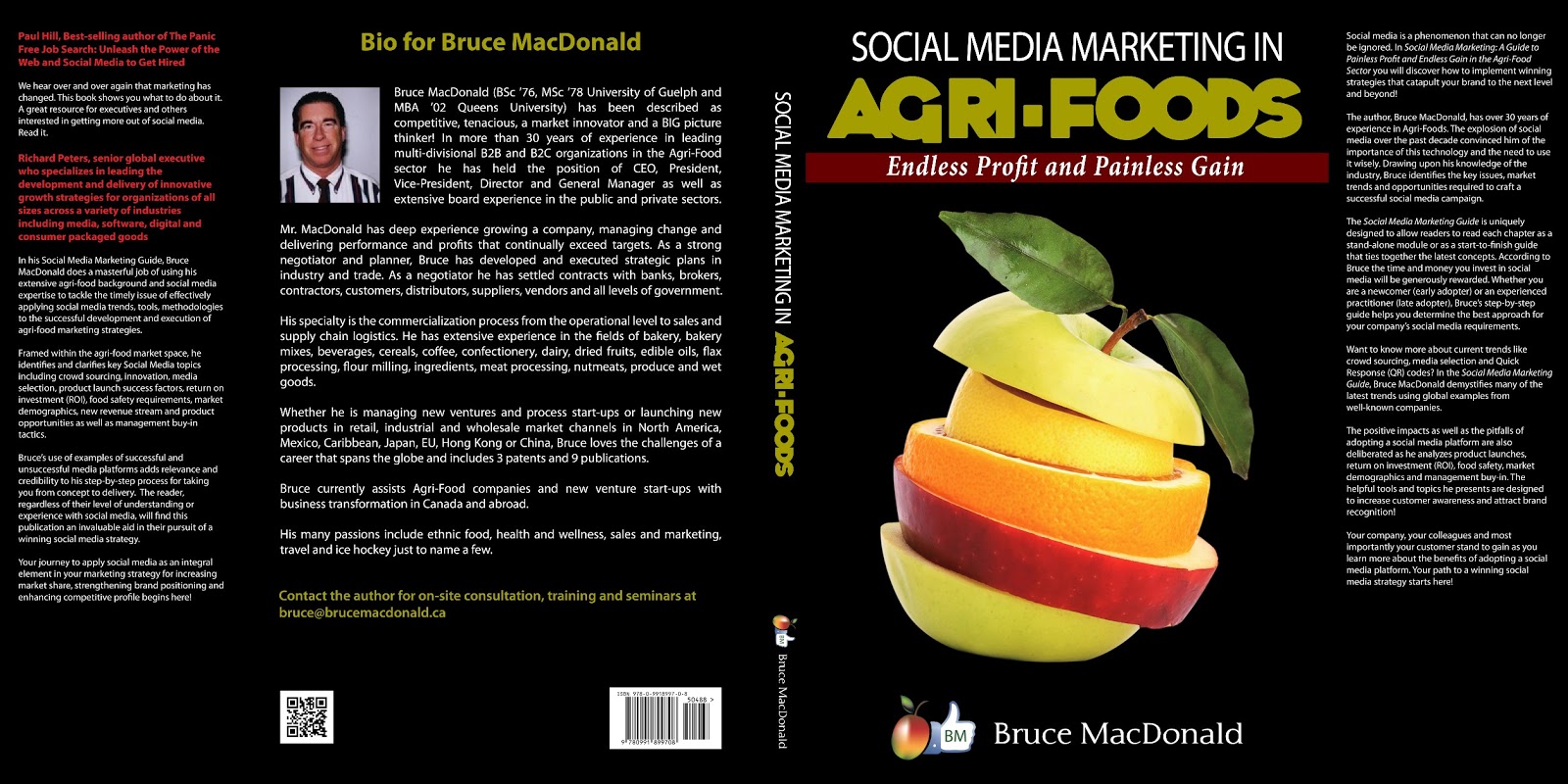
Social Media Marketing in Agri-foods:Endless Profit and Painless Gain

"Social Media Marketing in Agri-Foods: Endless Profit and Painless Gain"

My New e-book is available on-line at Lulu Publishing, Amazon and Kindle book stores for $4.99 USD.

This Social Media Marketing Guide is focused on the global food sector with helpful tools and topics designed to increase customer awareness and attract brand recognition.  Bruce tackles key issues, market trends, methodologies to design a successful marketing plan and opportunities required to craft a successful social media campaign.  

Loaded with examples of successful media platforms and those with shortcomings, he walks you through the step-by-step procedures from conception to delivery and all the tools along the way to create a winningsocial media strategy that your company and customers will surely adopt.  

Bruce analyzes various topics from crowd sourcing, innovation, media selection options, product launch success factors, return on investment (ROI), food safety requirements, Quick Response (QR) codes, market demographics, new market opportunities and management buy-in tactics.
Your new social media campaign to winning loyal customers starts here!

3 Food + Technology Trends Go Mainstream in 2012

Last year we saw the “end” of Twinkies, the explosion of caffeinated foods, and even DIY  marshmallows.

According to Forbes, three food issues of great importance finally made it into mainstream American consciousness in 2012, giving us hope for real change in the food system.  Food waste, humane animal treatment (including antibiotic use) and food labeling all took the leap and are now common household topics.
And in all three cases, people are using the internet and a host of apps to discuss these topics, to educate the public and to inspire each other to act, and buy, better.
1. Food Waste
A tremendous amount of attention is finally being paid to the amazing amount of wasted food in the world; by some estimates a full third of what is grown never makes it to the table (or to the animal trough, as the case may be).  The Natural Resources Defense Council, for example, just released a new study on “crop shrink” – the difference in the amount of food produced and that which is available in the market.  Turns out a full 30 percent of fruits and vegetables are often not even harvested (especially fruits like nectarines and plums), and another 30 percent maybe tossed simply because they don’t look perfect (yet are still perfectly edible).
This year too, a number of online resources worked to educate people about the issue and help them tackle food waste.   Love Food, Hate Waste is a UK based site providing resources to learn to waste less food.  Wasted Food is a blog which links readers to even more resources by Jonathan Bloom, the author of American Wasteland.  Tristram Stuart, who wrote Waste: Uncovering the Global Food Scandal, was invited to the prestigious TED Conference this year and gave a passionate, and convincing, talk about food waste.  New services to help limit food waste are also becoming available via the web – check out Compost Cab, for example, or the Gleaning Networkdeveloped by the Society of St. Andrew.
2. Humane Animal Treatment
Two popular American groups came out swinging in 2012 to promote better treatment of farm animals: the Humane Society of the United States andConsumers Union (a division of Consumer Reports).  Both helped bring important issues into mainstream consciousness and used social media to spread the word about their campaigns.
The Humane Society (in the U.S. and internationally) have long been critical of factory farming.  But in 2012 they took the fight up a notch and successfully pressured many large scale fast food and grocery chains to end the use of gestation crates in hog facilities.  The group has used its website to help promote “Humane Eating,”  meat-free meals, and runs an impressiveYouTube Channel with an entire section dedicated to issues in factory farming.
Consumers Union, on the other hand, is working to end the use of antibiotics in meat production.  The group has conducted independent tests, written countless articles and has appeared on major news networks speaking out against the practice.  They also began the “Meat Without Drugs” campaign online, where more than 550,000 people have now signed a petitionrequesting Trader Joe’s source and sell meat and poultry raised without antibiotics.
3. Food Labeling
Like the demand for better animal treatment, consumers are increasingly demanding better labeling of food products.
In California, the “Right to Know” initiative to label genetically engineeredfoods made it onto the ballot by collecting nearly one million signatures and launched an impressive social media campaign, trending 4 times on Twitter in the U.S. and receiving more than 2 million click-throughs on Facebook from Californians aged 18 and over.
In the end, the campaign lost by only 400,000 votes, but the fun has not stopped there.  Now Just Label It has launched a nation wide campaign to require genetically engineered foods to be legally labeled, and are running an online petition asking Congress and the Food and Drug Administration for better labeling.  Currently the petition has 1.2 million signatures and the campaign’s video has been watched almost 100,000 times.
But labeling demands are not only for GMOs.  Several class action suits made it into court this year questioning “all natural” labeling, and brands as seeming diverse as Ben and Jerry’s, Frito-Lay, and Tropicana are all currently defending how processes and ingredients not found in nature can be called “natural.”
Of course, technology has responded by making information more readily available about the food products lining your grocery shelves.  The Non-GMO Project (available for ipad/pod/phone only) lists foods certified “non-GMO,” and the Pesticide Action Network has released an app to help consumers better understand pesticides (also only for apple products).  And theFooducate app and website can help consumers wade through the existing labels on specific products to learn what is in them and what those ingredients and claims mean.